what is the transmission of values from one generation to the next called quizlet
INTRODUCTION TO POPULATION GENETICS
In this and the next few lectures we will be dealing with population genetics which generally views evolution as changes in the genetic makeup of populations. This is a somewhat reductionist arroyo: if we could understand the combined action of the forces that change cistron frequencies in populations, and then let this run over many generations we might sympathize long term trends in evolution. Continuing debate: can the processes of microevolution business relationship for the patterns of macroevolution? Population genetics is an elegant set of mathematical models developed by largely past R. A. Fisher and J. B. S. Haldane in England and Sewall Wright in the U.s.. Continues to be adult past many mathematical, theoretical and experimental biologists today (see J. Crow and M. Kimura Introduction to Population Genetics Theory).
In very elementary terms, population genetics involves analyses of the interactions betwixt predictable, "deterministic" evolutionary forces and unpredictable, random, "stochastic" forces. The deterministic forces are often referred to as "linear pressures" because they tend to push allele frequencies in ane direction (up, downward or towards the center). Important forces of this nature are selection, mutation, factor menstruation, meiotic drive (diff transmission of certain alleles [a form of selection]), nonrandom mating (besides a form of selection). The master stochastic evolutionary strength is genetic drift which is due to the random sampling of individuals (and genes) in small populations. It is important to realize that the deterministic forces may human activity together or against 1 another (e.g., selection may "attempt" to eliminate an allele that is pushed into the population past recurrent mutation). Moreover, deterministic forces may human activity with or confronting genetic drift, to make up one's mind the frequencies of alleles and genotypes in populations (e.g., cistron flow tends to homogenize different populations while migrate tends to make them unlike). Hence, the interaction of these forces is what nosotros are really interested in (a later lecture), simply since this tin can become very complex mathematically, nosotros will kickoff past analyzing one force at a time.
To begin nosotros need to understand some unproblematic population genetic "bookkeeping." Consider a locus with ii alleles (alternative forms of the Dna sequence that "reside" at that locus, e.g., one from female parent other from father). Now consider a population of N individuals (Due north=population size); this ways that there are 2N alleles in the population. Nosotros tin thus talk virtually genotype frequencies and allele frequencies. In a population of N = 100 individuals, if there are 25 AA, 50 Aa and 25 aa, then the genotype frequencies are f(AA) = 0.25, f(Aa) = 0.50 and f(aa) = 0.25. If we count up the individual alleles there are 200 of them (because there are 100 diploid individuals). Hence to determine the frequency of the "A" allele we accept to count each individual "A" allele that is specified in each diploid genotype. We go f(A) = (25+25+fifty) / 200 = 0.5. Nosotros mostly refer to the frequency of the "A" allele equally f(A) = p; the frequency of the "a" allele is f(a) = q. Note that p = (i-q) considering the sum of the allele frequencies must be i.0. Common "linguistic communication errors" in learning population genetics are to refer to the "p" allele when y'all really mean the "A" allele, or to say "the frequency of the p allele" when y'all really mean: "...p, the frequency of the "A" allele..." Got it?? Skilful.
Since evolution is modify in the genetic makeup of a population over time, a full general approach to modeling this is to decide the allele and genotype frequencies in the next generation (pt+1) that result from the action of a strength on those frequencies in the electric current generation (pt). Thus :
pt -> evolution happens -> pt+one
Consider a simplistic life cycle where the genotypes (a single locus mode of referring to adults) produce gametes. These gametes mate to class new genotypes (=adults). See 5.ane, pg. 93 and 5.iii, pg. 99. The relationship between allele frequencies (sometimes chosen "gene" frequencies) and genotype frequencies is determined past the Hardy Weinberg Theorem which defines the probabilities by which gametes will join to produce genotypes. Consider a coin toss: probability of a head = 0.5; of a tail = 0.5; prob. of 2 heads = 0.5x0.v = 0.25; prob. of one caput and ane tail = 0.5x0.5 = 0.25, etc. Each coin is analogous to the type of allele you lot can get from i of your diploid parents; the tossing of two coins is analogous to the mating of ii individuals to produce four possible genotypes (but heads,tails is the same as tails,heads). Now consider a roll of the dice. The probability of each face is 1/6, and is actually analogous to cases where more than 2 different alleles exist in the population at a given locus. The probability of whatever combination is one/6 x i/6 = ane/36. Only recall that there tin can exist more than one way to get many of the combinations (2,three is the aforementioned as three,two). The general expression for the number of genotypes that can be assembled from n different alleles is: [north(n+i)/2].
Assumptions of Hardy Weinberg: one) diploid sexual population 2) infinite size, 3) random mating, four) no pick, migration or mutation. This is a Cypher Model; obviously some of these assumptions will non hold in real biological situations. The theorem is useful for comparison to real-world situations where deviations from expectation may point to the action of sure evolutionary forces (e.m., mutation selection, genetic drift, nonrandom mating, etc.). Use a Punnet foursquare to determine genotype frequencies: f(AA) = ptwo, f(Aa) = 2pq, f(aa) = q2 and p2 + 2pq + qii = ane Learn this: One generation of random mating restores Hardy Weinberg equilibrium. H-West equilibrium is when the genotype frequencies are in the proportions expected based on the allele frequencies every bit determined by the relation p2 + 2pq + q2. This is derived more thoroughly in table 5.one, and accompanying text, pg. 94.
Example: consider a sample of 100 individuals with the following genotype frequencies:
| Observed Genotype Frequencies | Allele count | Allele frequency | Expected genotytpe frequencies under H-West | |
| BB | 0.71 | 142 B | p = 156/200 = 0.78 | p2 = (.78)ii = 0.61 |
| Bb | 0.xiv | fourteen B, 14 b | 2pq = ii(.78)(.22) = 0.34 | |
| bb | 0.15 | thirty b | q = 44/200 = 0.22 | q2 = (.22)two = 0.05 |
Observed are different from expected, thus some forcefulness must be at work to change frequencies.
NATURAL Selection
Choice occurs because different genotypes showroom differential survivorship and/or reproduction. If we consider a continuously distributed trait (e.g., wing length, weight) with a strong genetic basis, the response to option tin can be characterized by where in the distribution the "virtually fit" (greatest survivorship&reproduction) individuals prevarication. If after selection 1 extreme is most fit this is directional option; if the intermediate phenotypes are the most fit this is stabilizing selection; if both extremes are the almost fit this is disruptive selection.
R. A. Fisher proposed a simple bookkeeping, or population genetics, approach for ane locus with two alleles: we take AA, Aa and aa in frequencies pii, 2pq, q2 . Ascertain lii as the genotype-specific probability of survivorship, mii as the genotype-specific fecundity. We build a model that will predict the frequencies of alleles that volition be put into the gamete puddle given some starting frequencies at the preceding zygote stage;
| Genotypes | Zygote | -----> -----> | Adult | -----> -----> | Gametes |
| AA | p2 | lAA p2 | mAA lAA p2 | ||
| Aa | 2pq | lAa 2pq | mAa lAa 2pq | ||
| aa | q2 | fiftyaa q2 | maa laa q2 |
The gamete column is what determines the frequencies of A and a that will be put into the gamete puddle for mating to build the next generation'southward genotypes. We tin can simplify by referring to the fitness of a genotype equally wtwo = chiliad2 50ii . These fitness values volition determine the contribution of that genotype to the adjacent generation. Thus the frequency of A allele in the next generation pt+i (sometimes referred to as p') would be the contributions from those genotypes carrying the A allele divided by all alleles contributed past all genotypes:
pt+one = (wAA p2 + wAa pq)/(due westAA p2 + due westAa 2pq + waa q2). Or for the a allele,
qt+1 = (waa q2 + wAa pq)/(westAA p2 + wAa 2pq + waa qtwo). Notation that the heterozygotes are not 2pq just pq because in each example they are just being considered for the i allele in question. If we scale all wii's such that the largest = 1.0 we refer to these as the relative fitnesses of the genotypes. A worked instance where p = .four, q = .half-dozen and due westAA = 1.0 wAa = 0.viii due westaa = 0.6:
Genotype frequencies are p2 = 0.16, 2pq = 0.48, q2 =0.36, thus:
pt+1 = ((.16 10 1.0) + (.24 x .8))/((.sixteen x i.0) + (.48 10 .8) + (.36 x .6)) = .463; so q = .537 and thus f(AA)t+1 = .215, f(Aa)t+one = .497 and f(aa)t+ane = .288. Note both allele frequencies and genotype frequencies accept changed (compare to what we saw with inbreeding). This can exist continued with the new allele frequencies then on. When will the selection procedure stop? when D p = 0, i.due east., when pt+1 = pt . In some situations this will cease only when one allele is selected out of the population (p = 1.0).
Now nosotros can consider various regimes of selection (s = selection coefficient, (ane-s) is fitness):
| AA | Aa | aa | ||
| I | i | 1 | 1 - s | pick against recessive |
| Ii | 1 - s | 1 - s | 1 | selection against dominant |
| III | 1 | i - hs | ane - s | incomplete authorisation (0<h<1) |
| Iv | 1 - s | 1 | 1 - t | selection for heterozygotes |
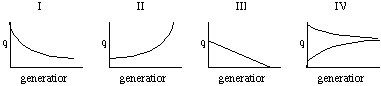
Substitute the fitnesses (wtwo) in condition I above into the expression D p = pt+ane - pt and testify for yourself that the equations on page 101 (eqn. 5.v) is related to the expression for pt+ane shown in a higher place. Kickoff 3 are directional in that selection stops but when allele is eliminated. In I the emptying process slows down considering equally q becomes small the a alleles are usually in heterozygote state and at that place is no phenotypic variance. In Two option is dull at first because with q small-scale almost genotypes are AA so there is low phenotypic variance; every bit selection eliminates A alleles q increases and the frequency of the favored genotype (aa) increases so selection accelerates. III is like the worked example run to fixation/loss. 4 is known as balancing pick due to overdominance (heterozygotes are "more" than either homozygote). Both alleles maintained in population past pick. This is an case of a polymorphic equilibrium (fixation/loss is also an equilibrium condition but it is not polymorphic). The frequencies of the alleles at equilibrium will exist:
pequil = t/(south + t); qequil = south/(s+t).
Classic example = sickle cell anemia. A=normal allele; S=sickle allele. South should be eliminated because sickle cell anemia lowers fitness. S is maintained where malarial amanuensis (Plasmodium falciparum) exists considering AS heterozygotes are resistant to malaria. Note that S allele is very low frequency where in that location is no malaria (the selective coefficient of S is different because the environment is different). See figure five.8, pg. 120; table 5.nine, pg. 119.
Another way that genetic variation can be maintained is through multiple niche polymorphism (polymorphism maintained by ecology heterogeneity in option coefficients). If different genotypes are favored in different niches, patches or habitats, both alleles can be maintained.
| AA | Aa | aa | |
| habitat 1 | 1.0 | 0.viii | 0.five |
| habitat 2 | 0.5 | 0.8 | 1.0 |
Heterozygotes volition have the highest average fitness although they are non the most fit in either habitat (run across effigy 5.12, pg. 124). The same dynamics would apply to temporal heterogeneity (spring and fall; wintertime and summer) bold that option did not eliminate one allele during the first period of selection. Classic example of temporal heterogeneity: third chromosome inversions of Drosophila pseudoobscura studied by T. Dobzhansky. Different chromosomal arrangements ("Standard" and "Chiricahua") prove reciprocal frequency changes during the year.
Still another way to maintain variation past option is through frequency dependent choice.
If an allele'due south fettle is non constant but increases as it gets rare this volition drive the allele dorsum to college frequency. Meet figure 5.9, pg. 121. Example: allele may give a new or distinct phenotype that predators ignore because they search for food using a "search image" (e.one thousand., I like the dark-green ones).
Almost (past no ways all) evolutionary biologists believe that choice plays a major role in shaping organic diversity, but it is often difficult to "see" choice. One reason is that selection coefficients can be quite small (i-s ~1) then the response to pick is pocket-size. When selection coefficients are large D p can be large, but the problem hither is that with directional choice fixation is reached in a few generations and we still can't "see" selection unless we are lucky enough to catch a population in the middle of the period of rapid change.
What affects the charge per unit of change nether selection? Call back that D p = pt+one - pt
D p = [(westAA p2 + due westAa pq)/(wAA p2 + wAa 2pq + waa q2)] - p . With some simple algebra nosotros can rearrange this
equation to: D p = (pq[p(wAA - wAa) + q(wAa - waa)])/(wAA p2 + wAa 2pq + waa q2)
Note that D p volition be proportional to the value of pq. This value (pq) volition be largest when p=q=0.5 or, in English, when the variance in allele frequency is greatest. This is a simplified version of the master betoken of the fundamental theorem of natural selection modestly presented by R. A. Fisher.
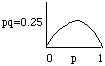
It states that the rate of evolution is proportional to the genetic variance of the population. In the above example we accept not explicitly divers the fitnesses wiis or the dominance relationships and these tin have a major effect on D p as written to a higher place.
Another important ascertainment for looking at this D p equation and plugging in some values is that option always increases the mean fitness of the population. For case with p=0.4, q=0.vi and wAA=ane, due westAa=0.eight and waa=0.half dozen, the mean fitness (west'bar') = 0.76. Afterward one generation of choice p' = 0.463 and q' = 0.537. Recalculating w'bar' we go wbart+1 = 0.78, which is greater than 0.76. When will this process end? At fixation (or equilibrium with overdominance).
This treatment of the algebra of natural selection illustrates what pick alone tin can exercise to allele and genotype frequencies. In the next lectures we will consider other evolutionary forces (mutation gene menstruation, genetic drift), how they human action alone, and eventually, how they interact with each of the other evolutionary forces.
mackerrasjustantrind.blogspot.com
Source: https://biomed.brown.edu/Courses/BIO48/6.PopGen1.HW.drift.HTML
0 Response to "what is the transmission of values from one generation to the next called quizlet"
Post a Comment